Both options get the job done. The right one depends on who your guests are, what your site can supply and how long the event runs.
What is the difference between a porta potty and a restroom trailer?
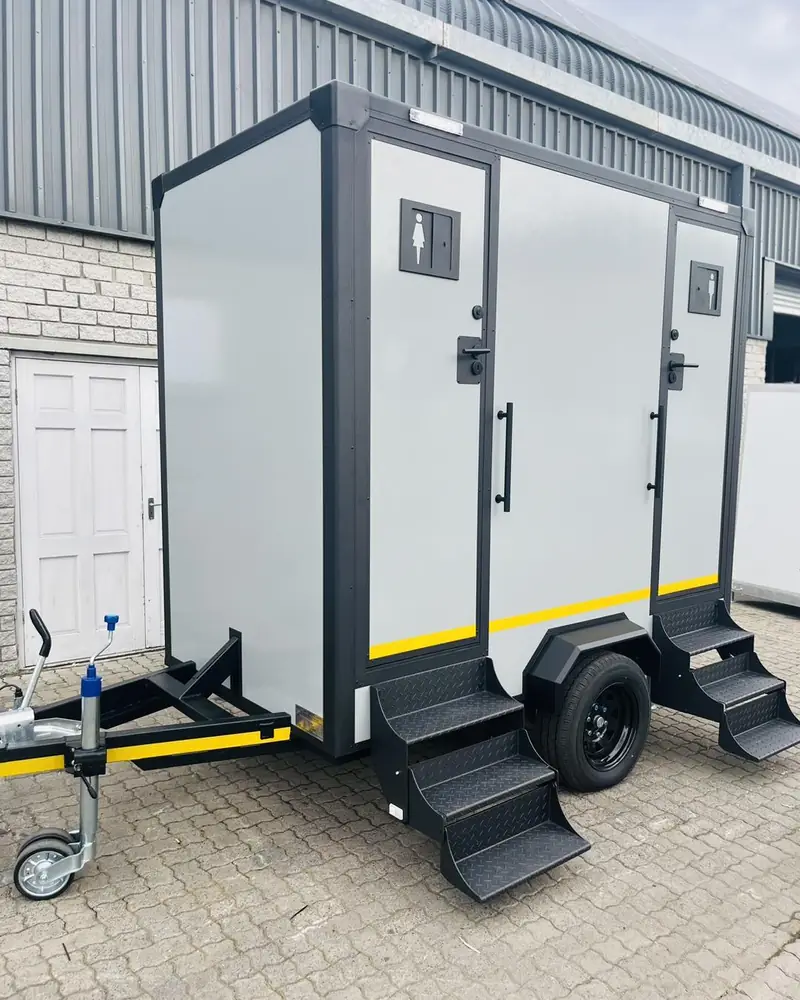
A porta potty is a single self-contained stall about 44 inches wide that needs no water or power. A 2-station restroom trailer has separate men's and women's entries, flush toilets, sinks with running water, mirrors, lights and climate control. The restroom trailer needs a 20-amp outlet, a garden hose and about 20 feet of level ground.
| Factor | Standard porta potty | Deluxe flushing unit | 2-station restroom trailer |
|---|---|---|---|
| Guest experience | Seat, urinal, sanitizer, vent; basic | Flush toilet, sink, mirror; nicer | Flush toilets, running water, lights, climate control; most like indoors |
| Hookups | None | None | 110V outlet on a dedicated 20-amp circuit (or generator) and a garden hose (or onboard tank fill) |
| Space needed | About 44 × 48 in footprint | Single-stall footprint | Level spot about 20 ft long plus truck access |
| Fits through a gate | A 48-inch gate on a dolly | Needs a clear, firm path | Needs a driveway or open access for the truck |
| Setup | Set in place in minutes | Set in place in minutes | Leveled, plugged in and hooked to water |
| Servicing | Delivered clean; mid-event service for multi-day events | Delivered clean; mid-event service available | Delivered clean; attendant or between-day restock |
| Best for | Parties, festivals, job sites, 5Ks | Backyard weddings, upscale parties | Weddings, galas, corporate and VIP areas |
Which one gives guests a better experience?
A restroom trailer gives guests the closest thing to an indoor bathroom: 2 separate entries, flush toilets, running water, mirrors, lights and climate control. A standard porta potty is clean and stocked but basic. A deluxe flushing unit sits in between, with a flush toilet and a sink but no power.
Dress matters more than most hosts expect. Guests in suits, long gowns or heels handle a lit, roomy trailer far better than a single stall at dusk.
For a casual cookout, field day or 5K, guests expect a porta potty. A trailer there can be more than the event needs.
What hookups and space does a restroom trailer need?
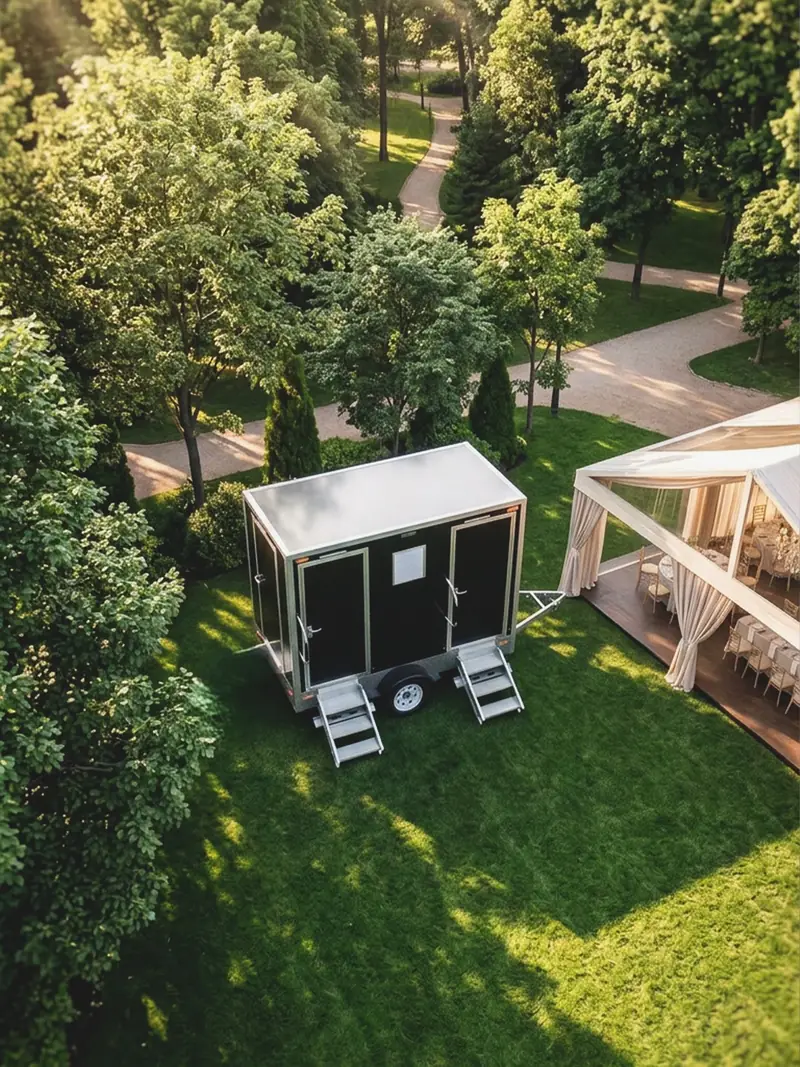
A 2-station restroom trailer needs a standard 110V outlet on a dedicated 20-amp circuit or a generator, plus a garden-hose water connection or a filled onboard fresh tank. The trailer also needs a level spot about 20 feet long that the truck can back into. A porta potty needs none of that.
- Power: find an outdoor outlet on its own 20-amp breaker, close to the trailer spot.
- Water: a working spigot within hose reach, or plan for the onboard tank.
- Space: about 20 feet of level ground, plus room for the truck to maneuver.
- Access: no low branches, soft lawn or tight turns between the street and the spot.
If any of those are missing, a deluxe flushing unit gives guests a flush toilet and a sink with zero hookups.
How does servicing differ between the two?
Event porta potties and restroom trailers both arrive clean, sanitized and stocked. For a 1-day event, neither usually needs service during the event. For multi-day events, porta potties get a mid-event service visit, while restroom trailers get between-day restocking or an attendant who stays on site.
An attendant is the best fit for long receptions and corporate events. Paper, soap and towels stay full and the floor stays tidy all night.
Long-term job site units follow a different schedule. Our guide to how porta potty servicing works covers weekly visits.
Which option fits a backyard or a tight venue?
A standard porta potty fits almost anywhere, since it rolls through a 48-inch gate on a dolly and needs no hookups. A restroom trailer needs a driveway or open lawn the truck can back across, plus about 20 feet of level ground. Fenced Nashville backyards usually point toward porta potties or deluxe units.
Walk the route from the street before you decide. Low branches, steep driveways, soft grass after rain and parked cars can all block a trailer.
Our placement guide covers ground, slopes and gates in detail.
Which should I choose? A quick decision checklist
Choose a restroom trailer if you can say yes to all 4 of these: guests are dressed up, a dedicated 20-amp outlet is nearby, a hose spigot or tank fill is available, and a 20-foot level spot has truck access. If any answer is no, choose porta potties or deluxe flushing units.
- Is this a wedding, gala, corporate or VIP event? Lean trailer.
- Is the spot behind a 48-inch gate or across a soft lawn? Lean porta potty.
- Is there no outlet or no water? Choose a deluxe flushing unit or standard units.
- Will anyone need ground-level entry? Add a wheelchair-accessible unit either way.
- Is food served away from a kitchen? Add a hand washing station.
To size the porta potty side, the porta potty calculator uses guests × hours ÷ 200 and adds units when alcohol is served.
Can I combine a restroom trailer with porta potties?
A hybrid setup works well for large events: 1 restroom trailer near the reception for guests, plus standard porta potties near parking, vendors and staff areas. Adding 1 wheelchair-accessible unit covers guests who cannot use trailer steps. The mix balances comfort, space and budget.
Hybrids also cut lines. Guests split between the trailer and the units, so nobody waits long during the busy stretch after dinner.
A common Nashville wedding setup is a trailer by the tent, a wheelchair-accessible unit beside it, and 2 standard units by the caterer. See our restroom trailer rentals or wedding porta potty rentals, or call (615) 237-6088 to talk it through.
The 5% wheelchair-accessible guideline we use comes from the 2010 ADA Standards, section 213.2. Confirm the requirement for your event with the venue or permit office.