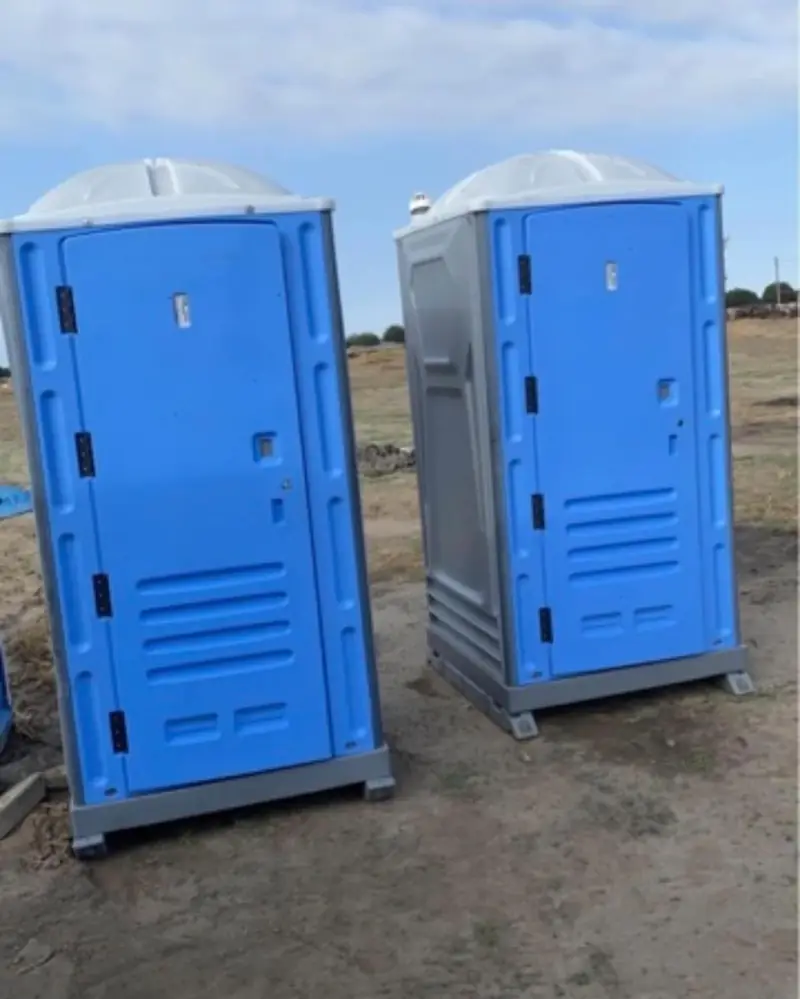
OSHA does not say "porta potty" anywhere. The rule is written for "toilets," and portable chemical toilets are one of the approved types for job sites without a sewer hookup. Below is the exact text you need, plus how we size real Nashville crews.
How many toilets per worker does OSHA require on a construction site?
OSHA requires 1 toilet for 20 or fewer workers on a construction site. At 20 or more workers, OSHA requires 1 toilet seat and 1 urinal per 40 workers. At 200 or more workers, OSHA 29 CFR 1926.51(c), Table D-1, sets the ratio at 1 toilet seat and 1 urinal per 50 workers.
Here is Table D-1 exactly as it appears in the regulation. You can read the full standard on the OSHA 1926.51 page.
| Number of employees | Minimum number of facilities |
|---|---|
| 20 or less | 1. |
| 20 or more | 1 toilet seat and 1 urinal per 40 workers. |
| 200 or more | 1 toilet seat and 1 urinal per 50 workers. |
Notice that "20" shows up in two rows. At exactly 20 workers, both rows give the same answer: one toilet. Treat any fraction of 40 (or 50) as a reason to add a unit, because a partial toilet does not exist.
What else does OSHA 1926.51(c) say about job site toilets?
OSHA 1926.51(c) has 4 parts that matter for porta potties. Table D-1 sets the count, (c)(2) requires at least 1 toilet under temporary field conditions, (c)(3) allows chemical toilets where there is no sewer, and (c)(4) exempts mobile crews with transportation readily available to nearby toilets.
- (c)(2) Temporary field conditions: "provisions shall be made to assure not less than one toilet facility is available." A short job still needs one.
- (c)(3) No sanitary sewer: sites may use privies, chemical toilets, recirculating toilets or combustion toilets, unless local codes say otherwise.
- (c)(4) Mobile crews: the toilet rules do not apply to crews with transportation readily available to nearby toilet facilities.
A home remodel crew using the homeowner's bathroom is a gray area. Most contractors skip the argument and rent a unit for the driveway. Our residential porta potty rental page covers that setup.
Worked examples: how many porta potties for 8, 25, 60 and 220 workers?
Under Table D-1, 8 workers need 1 toilet, 25 workers need 1 seat and 1 urinal, 60 workers need 2 seats and 2 urinals, and 220 workers need 5 seats and 5 urinals. A standard porta potty has 1 seat and 1 urinal, so those counts become 1, 1, 2 and 5 units.
| Workers on site | Table D-1 math | OSHA legal minimum | Our recommendation |
|---|---|---|---|
| 8 | 20 or less = 1 | 1 unit | 1 unit |
| 25 | 25 ÷ 40 = 0.63, round up to 1 | 1 unit | 3 units |
| 60 | 60 ÷ 40 = 1.5, round up to 2 | 2 units | 6 units |
| 220 | 220 ÷ 50 = 4.4, round up to 5 | 5 units | 22 units |
Legal minimum: OSHA Table D-1 is the floor. One standard unit can legally serve up to 40 workers once you pass 20 on site.
Our recommendation: plan 1 standard unit per 10 workers, rounded up, with weekly service. A 60-gallon tank shared by 40 people fills fast, and full units lead to complaints and lost work time. If you go above 10 workers per unit, add a second weekly service.
For crews that change size week to week, the porta potty calculator runs the same math for you.
Does OSHA require hand washing stations on job sites?
OSHA 1926.51(f) says lavatories must be made available in all places of employment, with running water, hand soap and individual towels. Crews that apply paint, coatings, herbicides or insecticides need washing facilities near the worksite. 1 hand washing station per 2 toilets is a simple way to plan coverage.
Mobile crews and normally unattended locations are exempt from the lavatory rule if transportation to nearby washing facilities is readily available. Every standard unit we deliver has a hand sanitizer dispenser, but sanitizer does not remove paint or chemicals.
For painting, drywall and landscaping crews, add a two-sided hand washing station with foot pumps, soap and paper towels. It needs no hookups.
What are the OSHA toilet rules for farms?
OSHA 1928.110 requires 1 toilet and 1 hand washing facility for each 20 employees or fraction thereof on farms. The facilities must be within a one-quarter-mile walk of each hand laborer's place of work. The rule covers farms with 11 or more employees doing hand-labor field work on a given day.
Field work of 3 hours or less does not require toilet and hand washing facilities under 1928.110(c)(2)(v). Read the full text on the OSHA 1928.110 page.
The quarter-mile rule matters on large Middle Tennessee farms. Two crews in fields far apart may need separate units, even if the head count is under 20.
Does Tennessee (TOSHA) have different porta potty rules?
Tennessee runs its own OSHA program, called TOSHA, under a federally approved state plan with final approval granted in 1985. TOSHA has adopted the federal OSHA standards for private employers and state and local government, so the 1926.51 Table D-1 count is the number to plan around in Tennessee.
TOSHA is part of the Tennessee Department of Labor and Workforce Development. Its safety and health resources are on the TOSHA safety and health page.
Federal job sites, like military bases, fall under federal OSHA instead. If a general contractor's site rules ask for more toilets than OSHA does, follow the stricter rule.
What else should a site plan include besides the toilet count?
A good job site plan covers 4 things beyond Table D-1: weekly service, a wheelchair-accessible unit when needed, placement the service truck can reach, and a hand washing station for dirty work. Each one keeps the units usable for the full 28-day billing cycle.
- Put units on level ground within easy reach of the service truck. See where to place a porta potty.
- Know what a service visit includes: pump out, scrub, fresh blue chemical, toilet paper and sanitizer. See how porta potty servicing works.
- Add a wheelchair-accessible unit if any worker or visitor needs ground-level entry.
- Spread units out on large sites so nobody walks across the whole lot to use one.
Need units on a Davidson County job site this week? Our construction site portable toilets come with weekly service built into the 28-day rate. Call (615) 237-6088 and we will size the order with you.
This article explains published federal rules and is not legal advice. Confirm site-specific requirements with TOSHA or your safety officer.